Spring 2026

Spring 2026

Making Tax Digital for Income Tax letters

With just one month to go before the first tranche of individuals are required to sign up to MTD for income tax, HMRC is writing to taxpayers it believes might be affected.
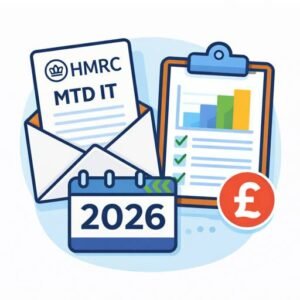
From April 2026, sole traders and landlords with qualifying income above £50,000, based on the information included in their 2024-25 self assessment tax return, will be required by law to join Making Tax Digital for income tax (MTD IT). Broadly, ‘qualifying income’ is combined income from trading and/or property (eg rental income) before deducting expenses.

MTD IT will extend to those with qualifying income over £30,000 from April 2027 and over £20,000 from April 2028. Income received from trading via a limited company or partnership is outside the scope of MTD IT and should not be counted towards your qualifying income.

This is a fundamental change to the way sole traders and landlords report their results to HMRC and will eventually apply to almost everyone who receives income from self-employment and/or property.

To comply with MTD IT, taxpayers will need to use software; apps; or spreadsheets to keep digital records; file quarterly summaries of their income and expenses; and complete a final annual submission of taxable profit for the accounting period at the end of the year. This will gradually replace the current self assessment tax return. HMRC is not providing its own platform for submitting updates and returns, so you will need to use third-party software. We can help you choose the right package for your business.

If you have received a letter from HMRC about MTD IT, we can help you calculate your qualifying income to determine whether you need to join and when. If you think your qualifying income for 2024-25 is over £50,000, do not wait to receive a letter from HMRC. Contact us today and we can help you sign up in good time and ensure you meet your filing obligations.

New penalties regime for all income taxpayers

The new points-based penalties system will apply to all self assessment taxpayers from April 2027, not just those within Making Tax Digital for income tax (MTD IT).

The new rules will apply first to taxpayers mandated to join MTD IT from April 2026 (those with qualifying income over £50,000); then to those required to join from April 2027 (qualifying income over £30,000). It was announced at Autumn Budget 2025 that the new regime will then apply to all income taxpayers, regardless of MTD IT status, from April 2027.

Points mean penalties

Under MTD IT, individuals will be required to file quarterly updates summarising their income and expenses. The deadlines for submitting quarterly updates are 7 August; 7 November; 7 February; and 7 May.

If you miss a submission deadline you will receive a penalty point. Once you have accumulated four penalty points you will receive a £200 penalty. For taxpayers filing annually (ie those outside the scope of MTD IT) the financial penalty will be triggered at two penalty points (ie two late annual returns).

Provided your points remain below your relevant threshold (fewer than four points for MTD IT) they will automatically expire after two years. Once you reach the threshold and incur the £200 penalty, subsequent late filings will not result in additional points but will instead trigger an immediate £200 penalty.

To reset your penalties to zero once you have reached the threshold you must complete a ‘period of compliance’ which requires filing a full year of submissions on time – four timely quarterly submissions for MTD IT, or two timely annual returns for those outside of MTD IT.

The good news is that for the first year of MTD IT no penalty points will be awarded for late quarterly updates. This applies only to the 2026-27 tax year, not to an individual’s first year of MTD IT. Therefore, if you join MTD IT in 2027-28 because your qualifying income exceeds £30,000, penalty points will apply from your first quarterly update.

Late payment

Under the current self assessment system, if you pay your tax liability after the deadline you have a 30-day window to make payment without incurring a penalty. The new regime reduces that window to 15 days. Penalties will be charged on a sliding scale depending on when payment is made:

  • day 15: 3% of tax outstanding*
  • day 30: a further 3% of the tax outstanding*
  • day 31 onwards: a daily penalty at 10% per annum.

*increasing to 4% from April 2027.

Late-payment interest will also apply to the outstanding balance. If you are unable to meet your income tax obligations on time, you can avoid penalties (but not interest) by setting up a Time to Pay arrangement with HMRC. We can help you with that.

Self assessment payments via PAYE

From April 2029, income tax self assessment taxpayers who also have PAYE income will pay some of their self assessment liability via PAYE.

Wages

Currently, if you owe additional tax due to a previous underpayment HMRC can collect that amount gradually by adjusting your tax code for the following tax year. This ‘coding-out’ adjustment increases the amount of tax deducted from your wages or pension each pay period so that you repay what you owe over the course of the year.

Coding out underpayments is generally automatic (subject to limits) but taxpayers can request an alternative repayment method, such as making a direct payment to HMRC or agreeing a Time to Pay arrangement.

From 2029, if a taxpayer is within both self assessment and PAYE, for example an office worker or pensioner who also earns rental income as a landlord, the employer or pension provider will deduct additional tax via PAYE based on the previous year’s self assessment liability. This suggests that coding out will become more widespread and potentially mandatory in many cases. As well as past underpayments, HMRC will use PAYE to collect current-year estimated tax.

The safeguard that ensures PAYE deductions do not exceed 50% of a taxpayer’s PAYE income for any pay period will remain in place.

Details of how this change will be implemented are expected later this year, following a consultation. We will provide affected clients with further information when it becomes available.

How winter fuel payments will be taxed

Most people who were eligible to receive the 2025-26 winter fuel payment (WFP) and did not opt out will have received it automatically in November or December 2025.

The payment is means-tested, so individuals with gross income for 2025-26 above £35,000 will be required to repay the full amount received. This is known as the WFP charge. If you are subject to the WFP charge and you usually file a self assessment tax return, the WFP will be added to your tax bill on your 2025-26 return. If you are taxed via PAYE, HMRC will recover the WFP through your payslips by changing your tax code. If you have not received a letter from HMRC notifying you of a change to your tax code, do not worry – you will receive a new code in April 2026. When it arrives, please let us know. You will not need to pay the WFP if you received any of the following benefits during the week commencing 15 September 2025:

  • income support;
  • income-based jobseeker’s allowance;
  • income-related employment and support allowance;
  • pension credit; and
  • universal credit.

If you opted out of receiving the 2025-26 WFP because you believed your income would exceed £35,000 for 2025-26, but you later discover that your income is lower than expected, you can opt back in. The deadline for this is 31 March 2026, so it is vital that you review your 2025-26 income before that date and contact us without delay if this applies to you.

A new opt-out is required each year for individuals in England, Wales and Northern Ireland. An online form to opt out of getting the WFP for 2026-27 will be available from 1 April 2026. Taxpayers in Scotland will not need to repeat the opting-out process; once you have contacted Social Security Scotland and opted out of receiving the pension age winter heating payment, the election remains in force for future years.

Private hire taxis excluded from VAT TOMS

From 2 January 2026, suppliers of most standalone private hire and taxi journeys can no longer use the tour operators’ margin scheme (TOMS).

Previously, some private hire operators, including certain app-based platforms acting as principal in supplying the journey, applied the TOMS to account for VAT only on the difference between what the passenger paid and what was paid to the driver. Under the new rules, that treatment is no longer available for standard taxi or private hire journeys supplied on their own.

Where the operator is acting as principal in making the supply to the passenger, it must account for VAT at 20% on the full fare charged to the customer, rather than just on its margin.

There is, however, an important exception. If a taxi or private hire journey is supplied as part of a wider eligible travel package, for example if it is bundled with accommodation or flights, and is ancillary to the main travel service, the TOMS may still apply to the overall package.

If you operate a private hire or taxi business and act as principal in supplying journeys to passengers you might need to move to standard VAT accounting and charge VAT at 20% on the full fare. This may require system and invoicing changes and careful consideration of pricing, cashflow and profitability. We recommend reviewing your contractual position and VAT treatment as soon as possible. We can assist with that review.

Changes to statutory sick pay

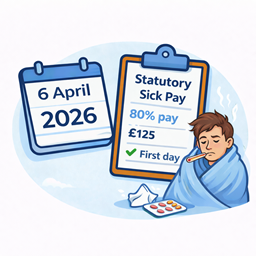
Two major changes to statutory sick pay will be introduced by the Employment Rights Act 2025 from 6 April 2026.
Statutory sick pay (SSP) is the minimum amount of sick pay that employers in the UK must pay eligible employees when they are off work due to illness.

To qualify for SSP an employee must be classed as an employee (not self-employed); have carried out work for their employer; and earn above the lower earnings limit (currently an average of £125 per week). From 6 April 2026, all employees will be entitled to SSP regardless of earnings, as the lower earnings limit will be removed in line with the Employment Rights Act 2025.

The amount of SSP will also change on 6 April 2026 to 80% of the employee’s normal weekly earnings (calculated over an eight-week reference period) or a weekly flat rate of £123.25, whichever is lower. Currently, SSP is not payable for the first three qualifying days of sickness. From 6 April 2026, eligible employees will receive SSP from the first qualifying day of sickness.

While the rules and rates are set by the Government, the financial cost of SSP is generally borne entirely by the employer and is not reimbursed by the Government. If you are an employer you should review your sickness absence policies and cost forecasts and update your payroll system in advance of the new rules. We can help with this.

APR and BPR restrictions relaxed

The Government has announced an easement to planned changes to business property relief (BPR) and agricultural property relief (APR) from 6 April 2026.

APR and BPR are valuable inheritance tax (IHT) reliefs that can reduce or even eliminate tax on farms and trading businesses passed on after death. They are designed to protect family-owned agricultural land and active businesses from having to be sold to pay an IHT bill.

At Autumn Budget 2024, plans were unveiled to significantly curtail APR and BPR from 6 April 2026. Under the original proposals, the 100% IHT relief currently enjoyed on unlimited business and agricultural assets would have been limited to the first £1m of assets, with the remainder attracting 50% relief. This would have resulted in an effective tax rate of 20% on assets above the threshold that would previously have been inherited tax free.

In response to strong opposition from businesses and the farming industry the Government has announced a relaxation of the plans, increasing the allowance from £1m to £2.5m of combined qualifying business and agricultural assets.

This follows easements announced at Budget 2025 confirming that the original £1m allowance would be transferable between spouses and civil partners. The increase to the threshold means that a surviving spouse or civil partner will now be able to pass on up to £5m of qualifying agricultural and business assets tax-free, on top of existing nil‑rate bands.  This will also apply to individuals who were widowed before the policy was introduced.

Contact us to explore how these changes could affect your succession planning arrangements.

Voluntary NICs for periods abroad

The Government has announced important changes to voluntary national insurance contributions (NICs) for individuals working abroad.

UK residents working abroad can currently pay voluntary Class 2 NICs to maintain their national insurance record. Voluntary Class 3 NICs are also available for periods abroad without strict residency requirements.

From April 2026 (for tax years 2026-27 onwards) voluntary Class 2 NICs for periods abroad will no longer be available. Individuals wishing to pay voluntary Class 3 NICs for time spent abroad will need to meet a new eligibility requirement: ten years of continuous UK residency or NICs. Shorter periods of UK residence will no longer qualify.

Individuals currently paying Class 2 NICs while abroad will be contacted by HMRC from July 2026 if the changes affect them. If you receive such a letter, please contact us. If you are currently paying by direct debit, there is no need to cancel payments. HMRC will automatically collect the final Class 2 payment for the 2025-26 tax year on 10 July 2026.

It is important to note that contributions for tax years prior to 2026-27 are unaffected. Anyone wishing to top up their NIC record for earlier years can continue to make voluntary contributions under the existing rules.

If you currently work overseas, we can help you review your national insurance record, understand your options, plan for the upcoming changes and ensure that your eligibility for the state pension and other benefits is protected.